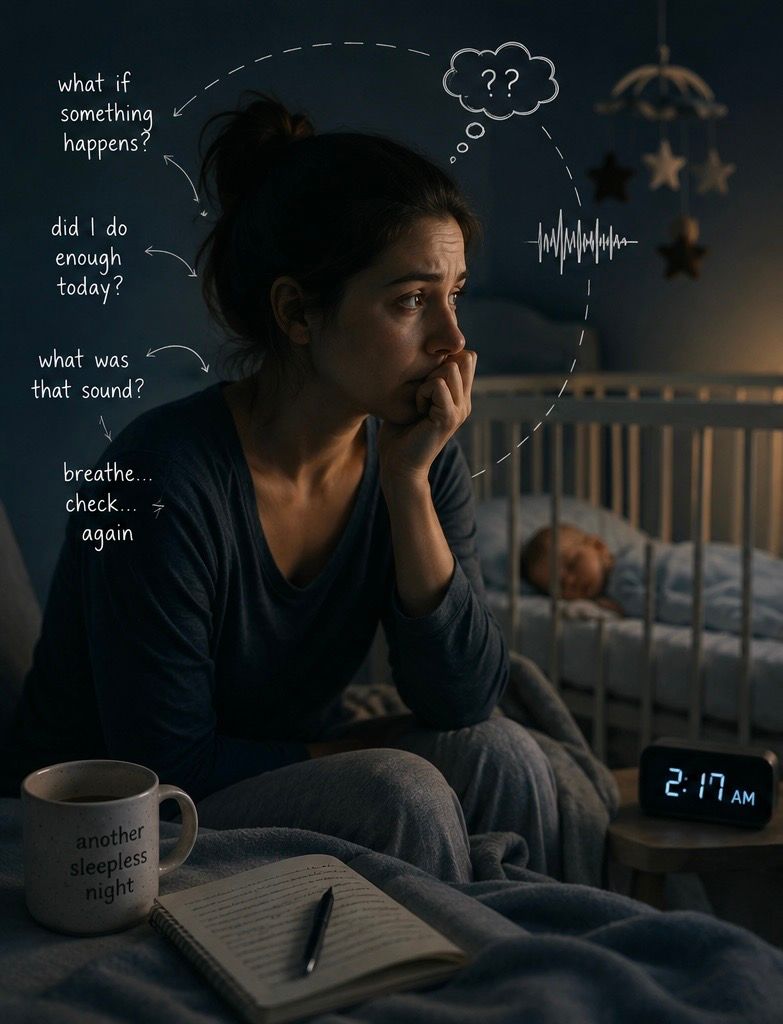
You finally get your baby to sleep.
The house is quiet, nothing is wrong, yet somehow, you still cannot relax. You listen for every sound. You check their breathing. You replay decisions from earlier in the day. You struggle to switch off, even when exhaustion is pulling at every part of your body.
For many mothers, this is not simply new-parent worry. It is hypervigilance.
Hypervigilance after birth is a heightened state of alertness in which the nervous system remains on guard, even when there is no immediate threat. While some degree of increased awareness is biologically normal in early motherhood, many women find themselves stuck in a cycle of scanning, anticipating and preparing for danger long after the moment has passed.
In my work with mothers through yoga therapy, I often hear similar experiences: “I can’t stop checking on the baby.” “I feel like I’m always waiting for something bad to happen.” “I’m tired, but I can’t switch off.”
These experiences can be linked to postpartum anxiety, difficult birth experiences, sleep deprivation, previous trauma, lack of support or simply the enormous responsibility of caring for a completely dependent human being.
The challenge is that hypervigilance can begin to feel normal. Many mothers assume they are simply being responsible, protective or attentive. Yet living in a constant state of physiological alertness comes at a cost. The body remains flooded with stress hormones. Muscles stay tense. Breathing becomes shallow. Sleep quality deteriorates. Recovery becomes more difficult.
Over time, mothers may feel disconnected from themselves, their partners and even the joyful moments of early parenthood. What fascinates me is that hypervigilance is not only psychological, it's embodied. You can often see it in the shoulders that never fully relax. In the jaw that remains clenched. In the breath that stays high in the chest. In the inability to truly rest, even when opportunities arise.
This is one reason I became interested in nervous system regulation and the mother–baby relationship.
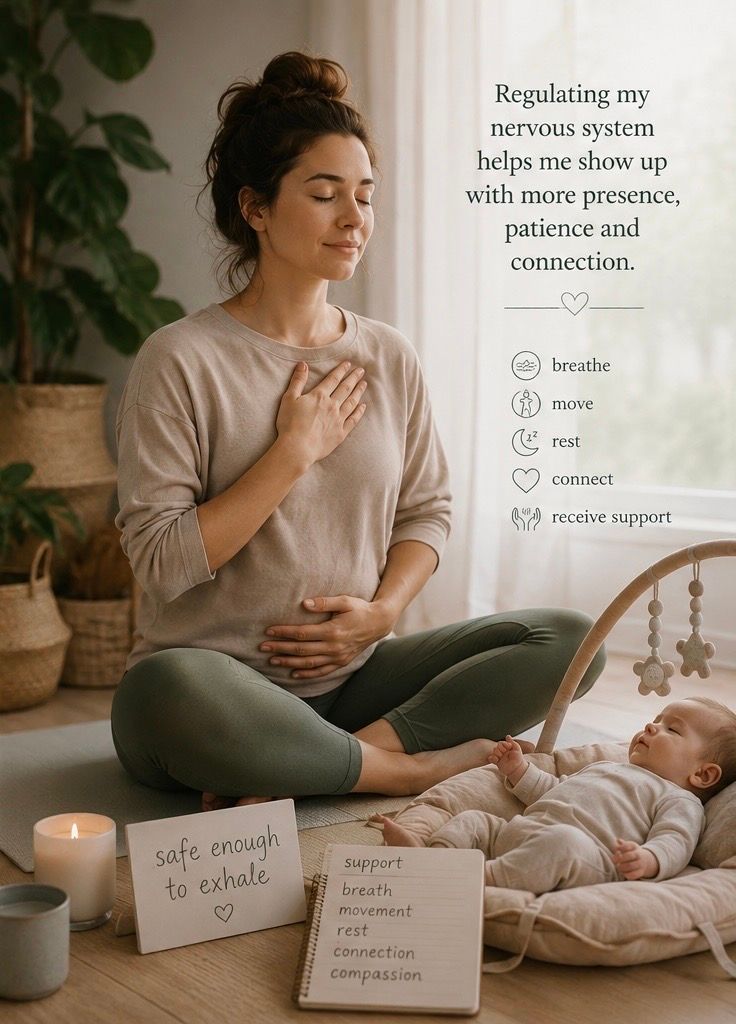
When a mother’s nervous system begins to feel safer, the effects often ripple outward. She may find herself sleeping more deeply, responding rather than reacting and feeling more present with her child. This does not happen through positive thinking alone, it happens through repeated experiences of safety in the body. Breathwork, mindful movement, guided relaxation, supportive touch, social connection and adequate rest can all play a role.
In yoga therapy, we use these tools not to “fix” mothers, but to help create conditions in which the nervous system can soften its grip on survival mode. Motherhood was never meant to be navigated in a state of constant vigilance. You deserve moments of ease too. And sometimes healing begins not by doing more, but by teaching the body that, for a moment, it is safe enough to exhale.